Why
cAIR? The
background to the conference
Issues
Approach
Participants
Model
Issues
Human
quality of life and survival depend
increasingly on how inter- and transcultural
issues are addressed.
Inter- and
transculturality have always been a part of the human condition, but
are becoming
increasingly relevant and critical
in a globalized
world in which
- social
and
cultural configurations are constantly changing as cultural boundaries
shift, cultural identities become more complex, and cultural
representations are renegotiated,
- technological
advances and economic constraints provoke and promote the international
mobility of cultural groups and cultural goods,
- political
parties and decision makers of all persuasions increasingly regard
inter- and transcultural issues as central to their strategies and
programs,
- global
issues
such as environment, defence, finance, and the distribution of wealth
and resources are - or should be - increasingly negotiated across
cultural boundaries, and
- intercultural
conflicts pose a constant threat to world peace and stability.
cAIR
is a response to the rising importance of
inter- and transculturality in national and
international politics, civil society, research and education -
reflected by the increasing frequency of media reports
addressing inter- and transcultural phenomena and questions of all
kinds. cAIR
- supports
civil society, government and education by improving
the
accessibility and usefulness of research that is relevant to their
concerns,
- empowers
researchers in all areas of inter- and transculturality and all
relevant
disciplines to contribute positively to social and political
developments,
- motivates
NGOs,
governments, academics, schools and universities to support each other
- and offers the means to do so,
- promotes
high-quality
projects by subjecting all submissions to careful, constructive quality
control by international experts, and
- encourages
universities to invest their personal, academic and financial resources
in Applied Interculturality
Research - a promising area of
interaction between research and society.
cAIR uses the term intercultural in the broad sense of
any interaction/s between or
among any cultures or cultural configurations. A culture is a group
of people with a common identity (including but not confined to names
of countries and cultural groups), common forms of behavior (including
but not confined to customs, traditions, manners,
expectations), common
ways of seeing the world (including but not confined to religions,
other beliefs and philosophies), and/or a common way of communicating
(including but not confined to languages). Cultural boundaries are
generally fuzzy, subjective, and in transition. Most people, including
those without a recent background of migration, have multiple identities in the sense
that they belong simultaneously to different cultural groups.
Interculturality generally includes transculturality, the merging
and converging of cultures; cultures are constantly changing
and being changed by their interaction.
Approach
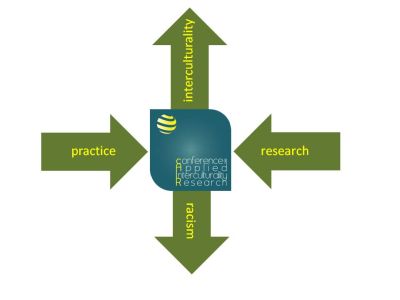 |
cAIR simultaneously
promotes constructive intercultural communication and understanding (an
aspect of social wellness)
and combats racism and
xenophobia (seen as a kind of social disease).
Because these two aspects interact and are often inseparable, we
simultaneously pursue both, aiming
for a balance between promotion of the positive and prevention of the
negative.
At the same time, cAIR brings together practice and research, promoting
their interaction and regarding them as inseparable. Again, we
simultaneously pursue both and aim for a balance.
The diagram on the left illustrates how these aims combine. On the
horizontal plane, practice and research come together to produce a new,
central synergy. This manifests itself in the vertical plane as a rise
in interculturality and a simultaneous fall in the prevalence and
impact of racism. |
Participants and their
communities
cAIR
brings
together communities
of practice on three different
levels:
- cultural
groups in the everyday sense of languages, religions and
traditions,
- NGOs
and
government, from local to global, and
- academic
disciplines and their contrasting approaches to research
(epistemologies).
cAIR
regards
all such groups,
actors, approaches and opinions as equally legitimate and valuable,
provided they are consistent with the Universal
Declaration of
Human Rights. cAIR also
respects existing
boundaries between communities of practice, however blurred. On that
basis, cAIR
promotes constructive
discourse among
communities with related goals. At the same time, cAIR
strives for high standards of quality, relevance and impact by
carefully evaluating project submissions. As far as possible,
evaluations are carried out within corresponding (sub-) communities
(areas of practice; academic disciplines). cAIR
does not support unlimited freedom of speech and will not offer a
platform to any project that the organisers or evaluators feel might
exacerbate xenophobia or discrimination of any kind. To our knowledge,
no previous international conference has aspired to achieve these or
similar aims.
Practice
Inter- and transcultural
projects, activities and interventions in civil society and government
can involve
- conflict
resolution at local, national and international levels,
- community
interpreting and the promotion of minority languages and
multilingualism,
- culture
(art,
music, literature, theater...),
- education
and
public awareness,
- employment,
equal opportunity, affirmative action and diversity
management,
- health,
medicine and therapy,
- immigration
and asylum,
- integration
of
cultural majority/minorities,
- legal
advice,
- military
peace-keeping operations,
- poverty
reduction and economic development (both local and global),
- relationships:
marriage, families, sexuality and reproduction, and
- religion,
spirituality, interfaith dialogue/pluralism and ecumenism.
Research
Interculturality
research addresses all kinds and aspects of inter- and transcultural
interaction.
Topic areas include
- ethnicity,
group membership and multiple/evolving cultural identities,
- alterity
(Otherness) and difference - and their (de-) construction,
- racism,
xenophobia, intolerance, discrimination and prejudice,
- the
history of
academic racism,
- cultural
and
evolutionary theories of altruistic and xenophobic behaviors,
- cultural
diversity and interaction - linguistic, religious, artistic, behavioral
and traditional,
- migration
and interactions among majority/minority cultures,
- parallel
identities/differences and interaction/discrimination in areas such as
gender, age/generation, and disability.
Relevant
academic
disciplines include aesthetics, anthropology, biology, cultural
studies, economics, education, ethnology, genetics, geography, history,
law, linguistics, literature, musicology, politics, physiology,
medicine, peace and conflict studies, psychology, philosophy, religious
studies, sociology, translation/interpretation and zoology.
Model
cAIR
is modeled
on the Conferences
on
Interdisciplinary Musicology -
an international yearly series
founded in 2004. CIM's
approach to bringing together humanities and sciences within musicology
is similar to cAIR's approach to bringing together practice and
research in interculturality